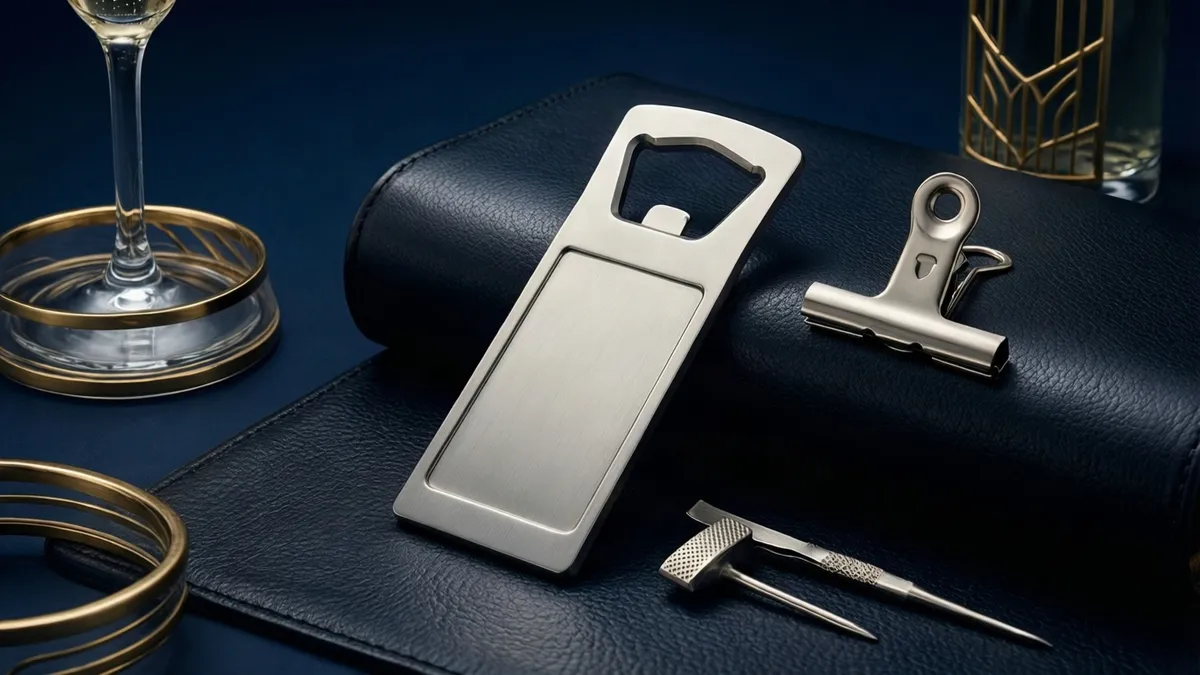
In short: Under $10, you're not buying a product — you're buying a name and a date. The gifts that don't look cheap are the ones with a big flat surface for engraving, not the ones with more gadgets. Judge every gift by its personalization surface area first, and you'll spend $10 like it's $40.
We write buying guides, not reviews: we haven't used every item on this page. Specs, prices, and personalization lead times come from the manufacturer or the listing, and whatever Amazon shows when you click is the authoritative figure.
This article contains affiliate links. If you buy through one, we earn a small commission at no extra cost to you. We only recommend what we would suggest to a friend.
The Federal Trade Commission's endorsement guides, 16 CFR Part 255, require a disclosure like that one to be difficult to miss, so it sits above every link here. Our full affiliate disclosure has the rest.
A $10 gift has one job. It carries a name, a date, and a thank-you, and it has to survive being handed to a grown adult without an apology. That's a narrow brief, and most of the market fails it — not because the products are bad, but because they're chosen as products instead of as canvases. Our full budget ladder lives in Groomsmen Gifts: What to Give, What to Spend, and When; this page is just the bottom rung, done properly.
The $10 Rule: You're Buying the Name, Not the Thing
Here's the reframe. At $40, a gift can carry itself: decent steel, real leather, weight in the hand. At $10, the product is filler. What the groomsman actually receives is the personalization, so the personalization is where your entire budget should be judged.
That flips the shopping question. Stop asking "is this a good bottle opener?" and start asking "how much room is there for a name?" A $10 item with a two-inch flat face reads as a keepsake. A $10 item with a logo-sized stamp reads as a party favor, no matter how many gadgets it has.
In our comparison of the six top guides on this topic, all six agree on the mechanism: personalization is what makes a budget gift feel meaningful and expensive. None of them, though, give you the tool that follows from it — surface area. So we will.
What Actually Looks Cheap at $10
Compare categories the way the gift will actually be received: by its flat spot, its afterlife, and its flop risk. Price bands below are ours, not a sourced figure, and reflect current listings at the time of writing.
| Gift | Personalization surface area | Post-wedding use | Risk of looking cheap | Typical per-head price |
|---|---|---|---|---|
| Bottle opener (steel, flat) | Large flat face | High — kitchens use these forever | Low | $5–$9 |
| Can cooler / koozie | Medium front panel | Medium — seasonal, replaceable | Medium | $3–$8 |
| Shot glass | Small, curved | Low — cabinet item | High | $4–$9 |
| Sunglasses (personalized arms) | Small arm strip | Medium — summer, breakable | Medium | $8–$12 |
| Socks (embroidered) | Small, but visible when worn | High — worn, not shelved | Low | $6–$10 |
Our take: Our call is the flat steel bottle opener first, embroidered socks second, and koozies only if the wedding is outdoors in summer. Shot glasses lose on every column that matters, and sunglasses sit right at the cap with a breakage problem. If your party is ten guys, the difference between a $6 and a $9 opener is $30 total — spend it on the heavier one.
Across the pages we analyzed, price mentions run roughly $8–$75 with a median around $20. This tells you something useful: the under-$10 shelf is the thin end of a market built for bigger spends. That's exactly why specificity beats quality here. Nobody manufactures a great $10 product; plenty of people manufacture a great $10 engraving.
The Gifts That Get Used on Tuesday
Non-drinkware wins the day-after test, and it isn't close. A personalized bottle opener goes on a keychain or a kitchen drawer and gets pulled weekly. Socks get worn. Engraved sunglasses ride in a car until a lens pops.
Cufflinks and tie clips deserve a mention, with a caveat. They're wedding-day accessories, so they pass the photo test by definition — but they live in a box afterward unless the guy wears a suit to work. Buy them for the party that dresses up, not as a default.
For the groomsman who doesn't drink, this whole tier is your answer. Socks, a tie clip, or an opener carry the same name and date as a shot glass without assuming a single toast. More on the drinking assumption in a moment, because it's where most budget lists quietly break.
Golf-obsessed party? A personalized golf ball marker or divot tool is the rare hobby gift that passes the surface-area test — small face, but used every round. That's the exception that proves the rule: hobby gifts work when the hobby supplies the use.
The Shot Glass Trap and the Flask Problem
Blunt version: most drinkware fails. A shot glass has a curved, thimble-sized surface, so your engraving shrinks to a monogram nobody can read from across a table. It then goes into a cabinet and stays there. Pint glasses do slightly better — bigger face, actual use — but at $10 you're at the bottom of the quality range.
Flasks are the category's oldest cliché, and we've been blunt about them before: cheap flasks leak, and the engraving is often the only decent thing about them. If a flask is non-negotiable for your group, read the listing's material spec (stainless gauge, screw-top seal) before you fall for the font on the preview image.
Koozies are the honest middle. They're cheap enough to buy one per groomsman plus a stack for the bachelor party, and a custom can cooler with a name and the date gets used all season. The trade-off: they fade, tear, and migrate to someone's car door. That's fine — a $5 gift is allowed to be consumable.
Personalization Is the Gift: Surface Area and Placement
Three words get used interchangeably and shouldn't be. Engraving cuts into metal or glass. Etching uses acid or a laser on glass. Embroidery stitches thread through fabric. On cheap items, engraving on solid steel looks the most expensive because it adds weight to the object's story without adding cost to yours.
Placement matters more than message. A name across the full face of an opener beats a tiny monogram in a corner. And get the monogram order right: first, last, middle — so "Thomas Alan Rayner" reads "TRA." Wrong order is the single most common mistake on personalized gifts, and it's invisible until the handover.
Here's our suggested engraving template, fill-in ready:
Line 1: [FIRST NAME] — or monogram Line 2: [ROLE] · [WEDDING DATE] — e.g., "Groomsman · 10.11.2026" Optional line 3: one inside joke, six words max
Skip anything longer. At small engraving sizes, long messages become unreadable texture. If you're weighing whether personalization is worth the lead time at higher budgets, Personalized Groomsmen Gifts: Mind the Lead Times covers the bigger-ticket versions.
Combine $10 Items So It Feels Like $40
One $10 item is a token. Two $5 items in a small box read as a set, and the presentation does the work a higher price would have done. A groomsmen gift box with an opener, socks, and a koozie lands differently than any one of them alone.
Do the math before you shop. Ten groomsmen at $10 is $100; at $8 with $2 of packaging per box, it's the same total, presented better. If you're setting the number against the rest of the wedding budget, How Much to Spend on Groomsmen Gifts: The Arithmetic walks the full tiers.
Same gift for everyone, then upgrade the best man. Matching sets photograph well and simplify ordering; the best man gets a tier above, per the norm on our budget page. One note worth knowing: the IRS's 2026 guidance on gifts is clear that gifts to individuals aren't tax-deductible. Don't let anyone talk you into a "business expense" framing — this is a personal thank-you, full stop.
Bachelor party favors and proposal boxes are adjacent uses for the same cheap items, but they run on different budgets and clocks. Asking the guys is its own decision; don't let a $10 cap govern it.
Ordering Lead Times: The Date Nobody Mentions
Personalized items are made to order, and production time is separate from shipping time. The listing states both; read them as two clocks, not one. Assume the busy season — roughly May through October — runs slower than the stated turnaround.
Five steps, in order:
- Count heads and set the per-head number first.
- Pick a category from the table above by surface area, not gadget count.
- Check the listing's stated production days against your wedding date.
- Order personalization at least a month out; add two weeks during wedding season.
- Order one sample of anything engraved before you buy ten.
That fifth step is the one that saves weddings. A single $9 sample tells you whether the engraving is deep, legible, and centered — information no product photo will give you. Retailers with fast domestic shipping can compress the shipping clock, but nothing compresses the production queue except ordering early. Our When to Give Groomsmen Gifts guide maps the handover timing, rehearsal dinner versus wedding morning.
FAQ: The Under-$10 Questions Nobody Answers
What are good groomsmen gifts under $10 that aren't barware at all?
Embroidered socks, a flat steel bottle opener, a personalized tie clip, or a custom golf marker. All four carry a full name and date and get used after the wedding, which is the test drinkware mostly fails.
What engraving message works best on a small gift?
Name or monogram on line one, role and date on line two, one short inside joke if there's room. Six words is the practical ceiling for a small face; beyond that, the text turns to texture.
How do I package a $10 gift so it feels more expensive?
A kraft or matte black box with tissue and a printed card does more than a $5 upgrade on the gift itself. Budget about $2 per head for packaging — on ten guys, that's $20 well spent.
Can I customize a cheap gift with a photo or an inside joke?
Photo printing works on koozies, socks, and pint glasses; engraving doesn't. Keep photo gifts to consumable or replaceable items, since a printed photo on a $4 object ages exactly as well as you'd expect.
Which gifts do groomsmen actually keep?
The ones attached to a routine: keychain openers, socks, golf markers, everyday sunglasses. Cabinet items — shot glasses, flasks, novelty glassware — are the ones that surface at a garage sale two years later.
How do I know a cheap gift won't look cheap when it arrives?
Order one sample before committing to the full count. Check three things in hand: engraving depth, construction weight, and whether the personalization sits centered on the flat face.
Tom Abernathy writes buying guides, not reviews; nothing here was tested by us.
Sources
- Internal Revenue Service — "Topic no. 506, Charitable contributions" (https://www.irs.gov/taxtopics/tc506) "Retrieved 2026-09-19".
- Federal Trade Commission — "Guides Concerning the Use of Endorsements and Testimonials in Advertising" (https://www.ftc.gov/legal-library/browse/federal-register-notices/guides-concerning-use-endorsements-testimonials-advertising) "Retrieved 2026-09-19".