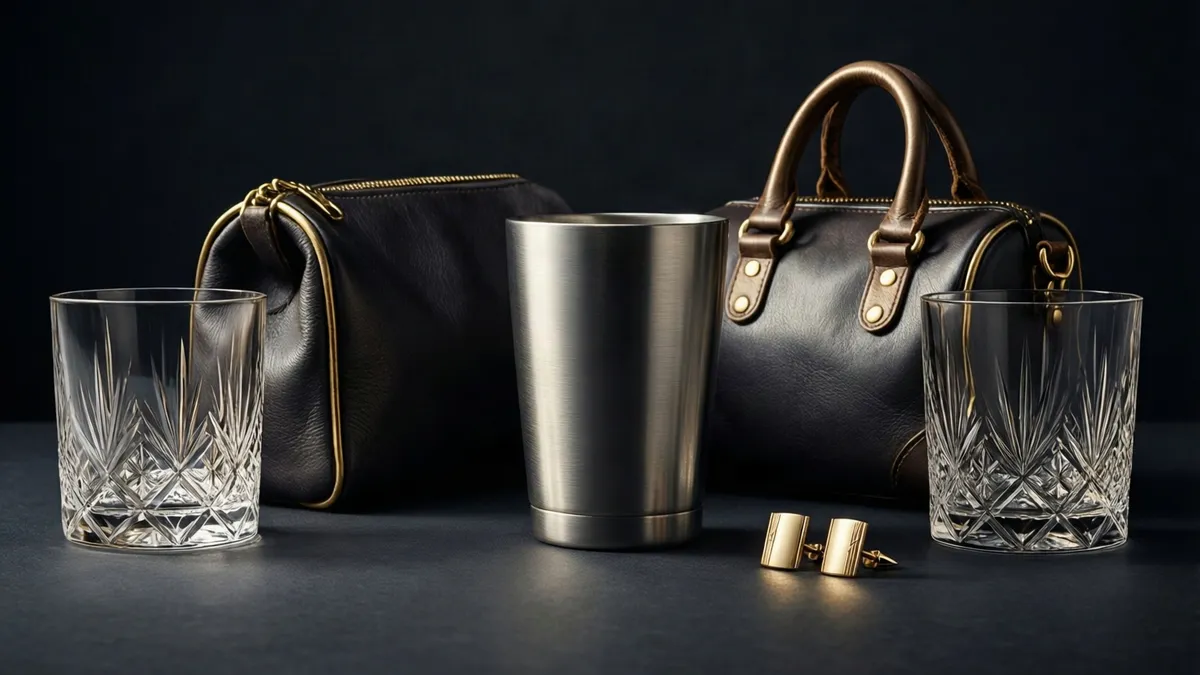
In short: Judge every groomsman gift by the day-after test: will it be in use a year from now, or in a drawer? That single question skips the engraved flask he will never refill and lands on the thing he reaches for on a Tuesday. Set a per-head budget first, order early enough to clear production time, and hand it over whenever the whole group is together.
We write buying guides, not product reviews. We have not used every item on this page. Specs and lead times come from the manufacturer or the listing, and whatever Amazon shows when you click is the authoritative figure.
This article contains affiliate links. If you buy through one, we earn a small commission at no extra cost to you. We only recommend what we would suggest to a friend.
The Federal Trade Commission's endorsement guides, 16 CFR Part 255, require a disclosure like that one to be difficult to miss, so it sits above every link here. Our full affiliate disclosure has the rest.
Search for groomsmen gifts and you get flasks, cigar cutters, and boxes printed with "Will you be my groomsman?" Some of it is fine. Almost none of it is chosen against the one test that matters: whether the gift survives the week after the wedding.
The better framework lives in our pillar guide, Groomsmen Gifts: What to Give, What to Spend, and When. This page takes one idea from it and builds the whole decision around the day-after test.
A gift has two moments. Only one counts.
A groomsman gift has two moments. The first is the handover: you pull it out at the rehearsal dinner, he says thanks, somebody takes a photo. That moment lasts for a short period of time.
The second moment is a year later. He is packing for a trip, opening a drawer, making coffee on a Tuesday. The gift is either in his hand or it is not. That is the moment you are buying for.
The day-after test is simple. Would he use this if it did not have his initials on it? If the answer is no, the engraving is doing all the work and the object is doing none of it. A good gift earns its place before the monogram goes on.
This reframes the thank-you tradition around something concrete. You are not shopping for a sentiment. You are shopping for an object that has to clear a bar every other gift in his life clears: useful enough to keep.
Run the numbers before you fall in love
Do the multiplication first. A groomsmen gift is one decision multiplied by five, six, or eight. At $40 each for six groomsmen you are at $240, and the best man's gift usually sits a tier above that.
A number you set first is a number you can hold. Without it, you find a $65 item that feels right, multiply by seven, and discover you are at $455 with the best man still to go. The per-head budget is the guardrail that keeps the day-after test honest.
The deeper guide on How Much to Spend on Groomsmen Gifts: The Arithmetic walks through the full formula. Pick a per-head number, multiply by your head count, add a percentage for the best man, and shop against the total.
One tax note. The Internal Revenue Service's 2026 gift tax exclusion is $19,000 per donee, so a groomsmen gift will not approach that ceiling unless you are giving something extraordinary. You do not need to file anything for a $40 knife or a $60 bag. The rule is generous enough that it will not affect your decision.
Price bands below are ours, not a sourced figure. A useful per-head range can be determined by multiplying a chosen amount by your head count and adding a percentage for the best man. Below $25 you are buying a trinket, and the day-after test will fail it. Above $100 you are buying a milestone gift, which is fine for a best man but disproportionate for the rest of the group.
The Library of Congress's wedding industry research collection compiles spending and party-size data from multiple sources, though figures vary by region and survey method. The point is not the number. Your head count and budget are the two constraints that should narrow your search before you open a single tab.
What passes, what fails, what depends
The five categories below show up on every gift guide, including ours. The difference is that we score them against the day-after test, not the handover photo. Monthly use, personalization effect, and move-survival are the three criteria. The verdict is ours.
| Category | Monthly use | Personalization effect | Move-survival | Verdict (ours) |
|---|---|---|---|---|
| Flasks and barware | Low | Negative | Low | Fail |
| Knives and multi-tools | Medium | Positive | High | Pass |
| Drinkware (tumblers, pint glasses) | High | Neutral | Medium | Pass |
| Travel bags and Dopp kits | Medium | Positive | High | Pass |
| Wedding-day accessories (cufflinks, ties, pins) | Low | Negative | Low | Fail |
A flask fails the day-after test because most people do not carry flasks. The one time it comes out is the wedding weekend, and then it lives in a drawer. Engraving makes it worse, not better, because a monogrammed flask cannot be regifted or used in public without explaining the initials.
Knives and multi-tools pass because they are tools. A good pocket knife gets used on packages, camp trips, and the kind of small tasks that come up weekly. Engraving on the handle is discreet enough not to interfere with use. Search pocket knives and multi-tools for options that fit this category.
Drinkware passes on volume. An insulated tumbler gets used daily, and the personalization is a color choice rather than initials. It survives moves because it is replaceable and useful enough that someone will always claim it.
Travel bags pass because they solve a problem the groomsman already has. A Dopp kit or garment duffle is something he would buy for himself. Engraving on leather or canvas wears in rather than wearing out. See travel bags and Dopp kits for examples.
Wedding-day accessories fail by definition. Cufflinks, ties, and lapel pins are props for the photo. They are fine to provide for the wedding, but they are not gifts in the day-after sense.
Our take: Skip the flask and the monogrammed cufflinks. Spend the same money on a pocket knife or a travel bag he would have bought for himself. The day-after test is not about being clever. It is about buying something that does not need the wedding to justify its existence.
Personalization is a test, not a default
Personalization is the default on groomsmen gifts, and it should not be. Engraving, etching, and embroidery only pass the day-after test if they make the gift more likely to be used, not less.
A monogram on a leather Dopp kit works because it ages with the object. A name etched on a pint glass is fine because the glass is functional and the etching is discreet. A wedding date engraved on a flask fails twice: the flask does not get used, and the date ties the object to a single day.
The rule is simple. Personalize if it adds ownership without adding sentimentality. Initials on a tool handle say "this is mine." A wedding date on a keepsake says "this is from an event." The first encourages use. The second discourages it.
Lead times are part of the test. Personalized items are made to order, and the production time runs before the shipping time. The listing states its own turnaround, and you should check it against your date before ordering. Assume the busy season is slower. Our guide on Personalized Groomsmen Gifts: Mind the Lead Times breaks this down in detail.
Avoid wedding-date-only engravings. If you personalize, use initials or a name. A date ties the gift to one day and makes it feel like a souvenir rather than a tool. The day-after test asks whether the gift belongs in his life, and a date stamp says "this belongs in a box."
Order deadlines and the two-week wedding
Custom gifts have two clocks. Production time is how long the maker needs to engrave, embroider, or assemble. Shipping time is how long the carrier needs to move it. They run sequentially, not in parallel, and both are stated on the listing.
The listing's stated turnaround is the only number you have. If it says 5 to 7 business days for engraving plus 3 to 5 for shipping, count ten business days minimum from the order date. Add a buffer, because the busy season is slower than the listing admits.
Here is a suggested timeline you can copy and adjust:
Order-deadline checklist (ours, adjust to your dates):
- Count backward from your wedding date. 2. Subtract 5 business days for shipping buffer. 3. Subtract the listing's stated production time. 4. Subtract 3 more business days for your own sanity. 5. That date is your order deadline. Write it down.
If your wedding is under two weeks out, you are past the custom-gift window. Buy ready-to-ship items and skip personalization entirely. A good knife off the shelf beats an engraved flask that arrives after the wedding. Search ready-to-ship groomsmen gifts for items that move fast, and filter for Prime delivery if you have it.
For the full timing breakdown, see When to Give Groomsmen Gifts (and When to Order).
When to hand over groomsmen gifts
The handover matters less than people think. The rehearsal dinner is the default. The morning of the wedding works. The bachelor party works too. What matters is that the whole group is together.
If not everyone can make the rehearsal dinner, pick the moment when the group is most complete. A gift handed to five of seven groomsmen and mailed to the other two is fine. A gift handed to each person individually over a week is awkward.
The timing question is really a logistics question. Can you get the gifts to the right place, wrapped, with cards, when the group is together? If the rehearsal dinner is the answer, use it. If the bachelor party is earlier and the full group is there, use that instead.
The edge cases: dropouts, refusals, and mixed parties
A groomsman drops out after you ordered personalized gifts. The gift has his name on it. You have two options: give it to him anyway as a thank-you for the support he did give, or hold it and give him something generic later. The first is more gracious. The second is more practical. Either way, do not ask for it back.
A groomsman refuses the gift. This is rare, but it happens, and it usually means he does not want to feel obligated. Respect it. A handwritten card thanking him for being in the party is enough, and it may mean more than the object would have.
You already paid for tuxes and the bachelor party. Do you still owe a gift? Yes, if you view the gift as a thank-you rather than a reimbursement. The tux and the trip are costs of the wedding. The gift is a personal acknowledgment. They serve different purposes, and one does not cancel the other.
The party is mixed-gender. Some members identify as groomswomen rather than groomsmen. The day-after test handles this automatically, because it judges the gift by use, not by gender. Buy the same category of gift for everyone, and vary the specific item by person. A knife for the outdoors type, a Dopp kit for the frequent traveler, a tumbler for the one who takes coffee everywhere. The category passes the test; the item matches the person.
For more ideas organized this way, see Groomsmen Gift Ideas That Outlive the Wedding Photo and Best Groomsmen Gifts by the Day-After Test.
How much should I spend on each groomsman?
A useful range involves a set amount per groomsman, with a higher amount allocated for the best man. A quick shortcut: take what you would spend on a nice dinner for two, and use that as your per-head number. The total, not the individual price, is what you shop against.
When do I give groomsmen gifts?
At the rehearsal dinner, the morning of the wedding, or the bachelor party, whichever has the most complete attendance. If the rehearsal dinner is formal and seated, the bachelor party is usually the better moment because the mood is looser and there is time to open things.
Is the best man's gift different from the rest?
Usually, yes. The best man typically gets a bigger or upgraded version of the same category, or a separate gift at a higher price tier. If the best man is also your brother or hosted the bachelor party, go to the top of that range or add a second, smaller item.
Can I give different gifts to different groomsmen?
Yes, and the day-after test encourages it. Matching gifts look good in the photo, but individual gifts match the person. The one rule: keep the price band consistent across the group so no one feels shortchanged. Vary the item, not the spend.
What if my wedding is in two weeks and I haven't ordered yet?
Skip personalization and buy ready-to-ship items. Filter for fast delivery, and choose items that pass the day-after test without needing a monogram. If even fast shipping is too slow, buy locally from a hardware store or outdoor shop. A store-bought knife in a nice box beats a custom order that misses the wedding.
Do I need to give gifts if I paid for tuxes and the bachelor party?
Yes, because the gift is a thank-you, not a reimbursement. The tux and the trip are shared costs of the event. The gift is a personal acknowledgment of his time and support. If the budget is tight after those costs, a handwritten note plus a $25 consumable, like good coffee or a local bottle, clears the bar.
Tom Abernathy writes buying guides, not reviews; nothing here was tested by us.
Sources
- Internal Revenue Service — "Frequently asked questions on gift taxes" (https://www.irs.gov/businesses/small-businesses-self-employed/frequently-asked-questions-on-gift-taxes) "Retrieved 2026-08-24".
- Library of Congress — "Reports & Statistics - Wedding Industry Research" (https://guides.loc.gov/wedding-industry/reports) "Retrieved 2026-08-24".
- Federal Trade Commission — "Guides Concerning the Use of Endorsements and Testimonials in Advertising" (https://www.ftc.gov/legal-library/browse/federal-register-notices/guides-concerning-use-endorsements-testimonials-advertising) "Retrieved 2026-08-24".